

Key Takeaways
- Virtual clothes try-on shows a shopper what a garment looks like on a body like theirs, by generating a new image rather than pasting a cutout over a photo.
- The virtual try-on pipeline has four stages: read the clothing item, map the body, drape the fabric, render the result.
- The distinction almost nobody draws: try-on is accurate about appearance, not about size. Those are two different problems, and only one of them is solved.
- U.S. shoppers returned an estimated 19.3% of online sales in 2025 (NRF and Happy Returns, 2025 Retail Returns Landscape), and each return costs roughly 27% of the item's price to process (Optoro).
- Apparel is the hardest category for virtual try-on technology to get right, and the one with the most to gain.
Full disclosure before you read any further. Rooop builds virtual try-on software. We have an obvious interest in you thinking it works. So this guide spends as much space on where virtual try-on breaks as on where it helps.
If you sell clothes online, you already know the shape of the problem. Someone orders three sizes of the same dress, keeps one, ships two back, and your margin on that order is gone. You cannot fix it with better photography, because the photo is of someone else's body.
That is the gap virtual clothes try-on is trying to close. Not by measuring anyone. By showing them.
This guide covers how virtual try-on technology actually works for clothing, category by category, including the parts vendors tend to leave out. By the end you should be able to tell whether it fits your catalog, and what integrating virtual try-on into your store would really take.
What Is Virtual Clothes Try-On, and Why Do Apparel Brands Use It?
Virtual clothes try-on is software that shows a shopper how a garment would look on a person's body, using a photo instead of a fitting room. Modern virtual try-on technology generates a new image of that person wearing the item, so fabric folds, shadows and lighting are produced rather than copied. Brands use it to cut sizing guesswork before checkout.
There are two delivery models, and they get confused constantly.
The first is AI photo-based try-on. The shopper uploads a photo, or picks a virtual model whose body is close to theirs, and the system returns a still image of that person in the garment. No camera permission, no app, works on a laptop. This is what most people mean now when they say they want to try on clothes virtually.
The second is AR try-on, which uses augmented reality and the live camera to overlay clothing on a moving body. It is the older approach, and it is genuinely better for a narrow set of products.
For clothing specifically, the AI approach has taken over, and the reason is boring. Fabric is hard. An AR try-on has to keep a garment glued to a body that is moving, in whatever lighting the shopper's bedroom happens to have, in real time. A generated still only has to be right once.
Who actually buys this? Mostly fashion brands with a returns problem they can quantify, catalogs between roughly 50 and 2,000 clothing items, and a product page that already converts reasonably. If your product page has other problems, a virtual try-on tool will not rescue it.
A note on vocabulary, because the category is a mess. Virtual fitting room, virtual dressing room, virtual try-on solution, virtual try-on feature, clothing try-on, try-on platform. Vendors use these interchangeably. They all describe some version of the same thing: letting a shopper see clothes on a body before they make a purchase.
Virtual try-on for fashion is the biggest slice of that market, and the try-on uses that actually matter commercially are narrower than the marketing suggests. People shopping online do not want a fitting room for its own sake. They want to know, in about four seconds, whether the thing will look right. A shopper who can virtually try a garment before buying is making a much smaller leap of faith than one staring at a stock photo.
How Virtual Try-On Technology Works for Clothing
Clothing try-on runs a four-stage pipeline. The system maps clothing away from its product shot, maps the shopper's body and pose, works out how that fabric should fall on that body, then generates a new image. Most current virtual try-on software uses a diffusion model for the last stage, which paints the result rather than compositing it.
Virtual try-on technology uses four stages, in this order:
- Garment recognition. Separate the clothing item from the background, sleeves from body, collar from shoulder.
- Body detection and pose mapping. Find the person, find their joints, work out how they are standing.
- Fabric simulation and draping. Warp the garment geometry onto that body shape and pose.
- Rendering. Generate the final try-on image, including folds, shadows and edges.
The interesting shift over the last two years is in stage four. Older systems warped a garment image and fused it onto the photo, which is why early virtual try-ons had that sticker-on-a-body look. Current research splits the job in two, handling geometric alignment first and texture refinement second, which is the approach behind recent models like DiffFit and the garment-focused diffusion work presented at ECCV 2024.

Garment Recognition: Reading the Clothing Item
The system starts with your product image and has to understand it as a garment, not as pixels. That means image segmentation to cut the item from its background, then a semantic pass that identifies the parts. Sleeve. Hem. Neckline. Placket. This is computer vision doing unglamorous work.
Which is why your product photography matters more than people expect. A flat lay on white, a ghost mannequin shot, or a clean on-model image all work. A lifestyle shot of a model half-turned in a field, with the garment partly occluded by an arm, does not. The system cannot infer the back of a jacket it has never seen.
Fabric type gets read here too, at least roughly. Matte cotton behaves differently from satin, and the AI algorithms need some signal about which one they are dealing with before they start generating highlights.
Body Detection and Pose Mapping
Next the system finds the person. Pose estimation locates the skeleton, shoulders, elbows, hips, knees, and builds a map of how the body is oriented. Some pipelines add a dense body representation, which assigns every visible pixel of skin to a position on a body surface model.
Body shape estimation happens alongside pose. Not measurements, to be clear. A shape prior, good enough to know that this person is broader through the shoulders than the reference model.
Bad input photos fail here more than anywhere else. Arms crossed over the chest, a heavily cropped frame, a busy background, or low light will all degrade the body map, and everything downstream inherits that error. If a virtual try-on experience feels unreliable to your shoppers, this stage is usually why.
Fabric Simulation and Draping
This is the stage that separates a realistic virtual result from the sticker effect. The garment geometry has to be warped onto the target body, which means predicting a deformation field: where each part of the fabric goes once it is worn by this particular person in this particular pose.
Cloth behaves in ways that are annoying to model. A stiff denim jacket holds its own shape and mostly ignores the body under it. A jersey dress does the opposite and reports every contour. A pleated skirt has structure that has to survive the warp, or the pleats smear.
Older pipelines predicted a dense flow map and warped explicitly. Newer ones feed that flow into the generative model through cross-attention, so geometry and appearance are decided together rather than in sequence. The practical result is fewer broken sleeves and fewer virtual garments that float half a centimetre off the shoulder.
Rendering the Try-On Image
The last stage produces the picture. A diffusion model starts from noise and denoises toward an image that satisfies two constraints at once. It should look like this person, and they should be wearing this garment.
Because it is generating rather than copying, it can invent things a paste job cannot. The shadow under a hem. The way a collar sits slightly open. The compression where a strap crosses a shoulder.
It can also invent things that are wrong, which is the honest trade. Generated images hallucinate. A logo can smear. A button placket can drift out of alignment. Any brand shipping this to customers needs a review step, which we get to later.
AI or AR Try-On: Two Ways to Try Clothes Virtually
AI try-on generates a still image from an uploaded photo. AR try-on overlays clothing on a live camera feed using augmented reality. For clothes, AI wins on fabric realism, device support and integration effort. AR technology keeps an edge for rigid, face-anchored products like glasses and for in-store mirror installations.
| AI-powered virtual try-on | AR try-on | |
|---|---|---|
| What the shopper supplies | A photo, or picks a virtual model | Live camera access |
| Device requirements | Any browser, any device | Camera, decent processor, permission granted |
| Output | A still try-on image | A moving overlay in real time |
| Fabric realism | Strong. Folds and shadows are generated | Weak on drape, better on rigid items |
| Best-fit products | Apparel and most soft goods | Eyewear, watches, some jewelry, in-store mirrors |
| Integration effort | Product-page widget plus catalog prep | SDK, device testing, permission flows |
| Common failure | Hallucinated detail, smeared logos | Tracking drift, lighting mismatch |
I want to be careful here, because "AR is dead" is a claim vendors on the AI side make too easily and it is not true. If you sell sunglasses, AR anchored to face landmarks is still the better technology. If you run physical stores and want a smart mirror, augmented reality is the only option that makes sense. Virtual reality headsets are a third path, and for mainstream online shopping they remain a demo rather than a channel.
For a clothing brand selling online, though, the calculus is different. Shopify's own analysis of more than 100,000 stores found that 50.3% of ecommerce traffic came from mobile devices. Asking a shopper on a phone to grant camera access, stand back far enough for a full-body frame, and hold still is a lot of friction to add before a purchase.
For a deeper comparison of the two approaches, see our guide on AI vs AR virtual try-on, and on the older 2D and 3D split, 2D vs 3D virtual try-on technology.
The AI Models Behind Virtual Clothing Try-On
Clothing try-on models come from two lineages. GAN-based systems warp a garment then fuse it onto the person. Diffusion-based systems generate the whole image conditioned on the garment and the body. Nearly all recent work is diffusion, usually in two stages: align the geometry, then refine the texture.
The short history. Early try-on networks used a two-step strategy: deform the garment to match the person's pose, then hand both to a generator that fused them. It worked well enough for flat, front-facing shots and fell apart on anything else.
Diffusion changed the ceiling. Research groups moved to latent diffusion, sometimes with two parallel networks handling the garment and the person, and output quality jumped. The current generation splits geometric alignment from texture refinement into separate stages, which is what DiffFit documents, and feeds warp information into the diffusion process through attention rather than pre-warping the image outright.
What this advanced AI means for you, practically: model quality is now the main differentiator between virtual try-on tools, and it is improving fast enough that a demo you saw eighteen months ago is not representative. Ask for a test on your own clothing items, not on the vendor's showcase catalog.
A try-on tool powered by AI helps brands cover a whole catalog without commissioning a shoot per garment. Because it uses AI rather than hand-built 3D assets, the marginal cost of the next SKU is close to zero, which is the real reason the economics flipped.
If you are more interested in the generation side, changing outfits on model photos for catalog and marketing use, that is a different application of the same AI technology, covered in our guide to AI clothes changer technology.
Virtual Try-On for Different Clothing Categories
Accuracy is not uniform across a catalog. Here is roughly where each category sits, and this is the part most vendor pages skip entirely.

Shirts and Tops
The easiest category, and the one every virtual try-on solution demos. Tops sit close to the torso, have simple geometry, and are usually photographed flat or on a mannequin. Prints and stripes hold up reasonably. Small chest logos are where you will see the most artefacts, because fine detail is exactly what generative models smudge.
Pants and Bottoms
Harder than tops, for an unglamorous reason. The source photo usually crops at the waist. If the shopper's photo does not show their legs, the system has to generate them, and generated legs are where uncanny creeps in. Full-body input photos fix most of this.
Rise and break length are the two things try-on gets wrong most often. A high-rise trouser rendered at mid-rise looks fine and is still misleading.
Dresses
The showcase category and the difficult one at the same time. Dresses cover the most body area, which makes the payoff big, but they also involve the most fabric movement. A structured shift dress renders cleanly. A tiered chiffon maxi is a genuine challenge, because the model has to invent how several layers of sheer fabric stack.
We go into this in depth in our guide on virtual try-on for dresses.
Jackets and Outerwear
The weakest category for current virtual try-on technology, and vendors rarely say so. Outerwear is structured, meaning it holds a shape independent of the body. It is also usually worn over other clothes, so the system has to render a layered look from a single garment image. Puffer jackets, tailored blazers and anything with a defined shoulder are where you should expect the most rework.
Activewear
Surprisingly good. Activewear is close-fitting, made from consistent stretch fabrics, and usually photographed on-model against clean backgrounds. Compression garments render well because the fabric follows the body rather than hanging off it. Reflective trims and mesh panels are the two things to watch.
Virtual Try-On for Different Clothing Styles and Bodies
Casual Wear
Jeans, tees, knitwear, everyday layers. This is the volume category for most fashion ecommerce brands and it is well served. Simple silhouettes, forgiving fabrics, and shoppers who are not agonising over millimetres of fit.
Formal Wear
Higher stakes, higher difficulty. Tailoring is about precision, and virtual try-on is not a precision tool. It can show a shopper the color, the drape and the overall silhouette of a suit or a gown. It cannot tell them whether the shoulder seam will land correctly, and pretending otherwise is how brands end up with disappointed customers.
Use it for style confidence, and keep a human fit consultation in the loop for made-to-measure.
Plus-Size Clothing
This is where the industry has historically been worst and where the improvement matters most. The old failure mode was training data. Models trained overwhelmingly on straight-size fashion photography produced distorted results on larger bodies, which is both a quality problem and an obvious dignity problem.
The fix is training data breadth, and it is worth asking any vendor directly how their model performs across body sizes and asking to see the test. If they only show you one body type, that answers the question.
Children's Clothing
Two complications. First, children's proportions change fast and differ sharply from scaled-down adult proportions, so a model tuned on adult bodies renders kids badly. Second, and more important, uploading photographs of children to a third-party service raises privacy questions most brands have not thought through.
The safer pattern for kidswear is stock child models rather than shopper-uploaded photos.
Where Clothing Try-On Still Breaks, and How Modern AI Handles It
Every vendor page lists benefits. Almost none list failure modes. Here are the four that will actually cost you time.
Fabric Draping
Sheer, reflective, and heavily textured fabrics remain hard. Chiffon and organza involve semi-transparency, which means the model has to render what is behind the fabric as well as the fabric itself. Sequins and satin involve specular highlights that shift with body position. Expect these items to need manual review.
Modern two-stage pipelines have improved this considerably by separating the geometry problem from the texture problem. Improved is not solved.
Different Body Types
Coverage across body types depends entirely on training data. A model that has seen a narrow slice of bodies will produce a narrow slice of good results. This is testable. Run your own set of source photos across a range of sizes and heights before you sign anything.
Size Variations
Here is the honest limit. Most virtual try-on tools render a garment at a single visual scale. They are not simulating your size 6 versus your size 16 as different physical objects with different pattern grading. A shopper looking at a rendered try-on is seeing style, not their size.
Some vendors are working on size-aware rendering. Treat any claim that it is solved with scepticism until you have tested it on your own graded patterns.
Movement and Fit
A still image cannot show you how a garment moves. Whether a skirt swings, whether a sleeve rides up when you raise your arm, whether a waistband stays put. Video try-on is an active research area and the results are getting better, but for now this is a real gap between a virtual fitting room and a physical one.
How Accurate Is Sizing in a Virtual Fitting Room?
Try-on accuracy and sizing accuracy are two different things. Current systems are good at appearance, showing color, silhouette, drape and proportion on a body like the shopper's. They are not measurement tools. A virtual fitting room does not replace a size chart, and no honest vendor claims it does.
I think this is the single most oversold thing in the category. Marketing copy slides from "see how clothes look on you" to "find your perfect fit" without acknowledging that those need completely different technology underneath.
Appearance accuracy comes from generative rendering. Size accuracy would need body measurement, garment pattern data with real grading, and a fit model. Some companies do exactly that, it is a legitimate and separate product category, and it is usually sold as fit prediction rather than as a virtual dressing room.
What this means for your product page: run both. Virtual try-on for confidence about style, a good size chart and fit guidance for confidence about size. Together they cover most of why people return clothes. Alone, either one leaves a gap.
Our virtual fitting room technology guide goes further into the fitting room side specifically, and our piece on trying clothes at home covers how shopper behavior is shifting away from the in-store fitting room.
How Does Virtual Try-On Reduce Clothing Returns?
Return rates fall when shoppers buy with fewer open questions. Virtual try-on removes the "I cannot tell what this looks like on someone shaped like me" question, which drives a large share of apparel returns alongside sizing. It does not remove the sizing question, so virtual try-on reduces returns rather than eliminating them.
The scale of the problem, from primary sources:
- U.S. shoppers returned an estimated 19.3% of online sales in 2025, per the National Retail Federation and Happy Returns, 2025 Retail Returns Landscape. Across all retail channels, returns totalled $849.9 billion, or 15.8% of annual sales.
- Processing a return costs an average of about 27% of the item's purchase price, according to Optoro, which is enough to erase a large share of the margin on the sale.
Clothing is where this bites hardest, and the reason is structural rather than statistical. A book that arrives is the book. A jacket that arrives is a negotiation between a photo, a size chart, and a body. Every one of those steps is a place for the purchase to go wrong.
Rooop's own numbers, and please read them as first-party data rather than independent research: across our customer base, return rates fall by roughly a third on average after virtual try-on goes live on product pages. Two caveats I would want if I were reading this. Our customers self-selected for having a returns problem worth solving, and most brands change more than one thing at a time, so attributing all of a move to one virtual try-on feature is generous.
Run it as a proper test if the number matters to your business case. Hold out a portion of traffic, measure return rate by SKU, and give it a full return window before you call it.
Benefits of Virtual Try-On for Fashion Brands and Shoppers
The benefits of virtual try-on split cleanly into two lists, and they are not the same list.
What retailers get:
- Fewer sizing-driven returns, which shows up directly in contribution margin
- A higher conversion rate on product pages where visualization was the blocker
- Longer sessions and more clothing items viewed per visit
- Fewer "what does this actually look like" support tickets
- Product imagery that scales across body types without a new shoot for each colorway
What shoppers get:
- Seeing a garment on a body closer to their own than the catalog model
- Less bracket-ordering, which means less packing, less shipping, less waiting
- Faster decisions on styles they would otherwise skip
- A more interactive shopping experience on a product page that used to be static
- A reason to trust a fashion brand they have not bought from before
The shopper-side benefits are the ones that compound. A customer who did not have to return their first order is a customer who orders again. That is the whole online shopping experience argument in one sentence, and it is why virtual try-on provides more value on repeat-purchase categories than on one-off ones.
It is also why the fashion industry has moved on this faster than most other retail verticals. The brands that benefit from virtual try-on most are the ones treating it as part of the product page's user experience rather than as a bolt-on widget, and using it to personalize what a shopper sees rather than to decorate the page. Handled that way, virtual try-on technology allows a brand to answer a question a size chart alone never could.
Integrating Virtual Try-On Into Your Apparel Store
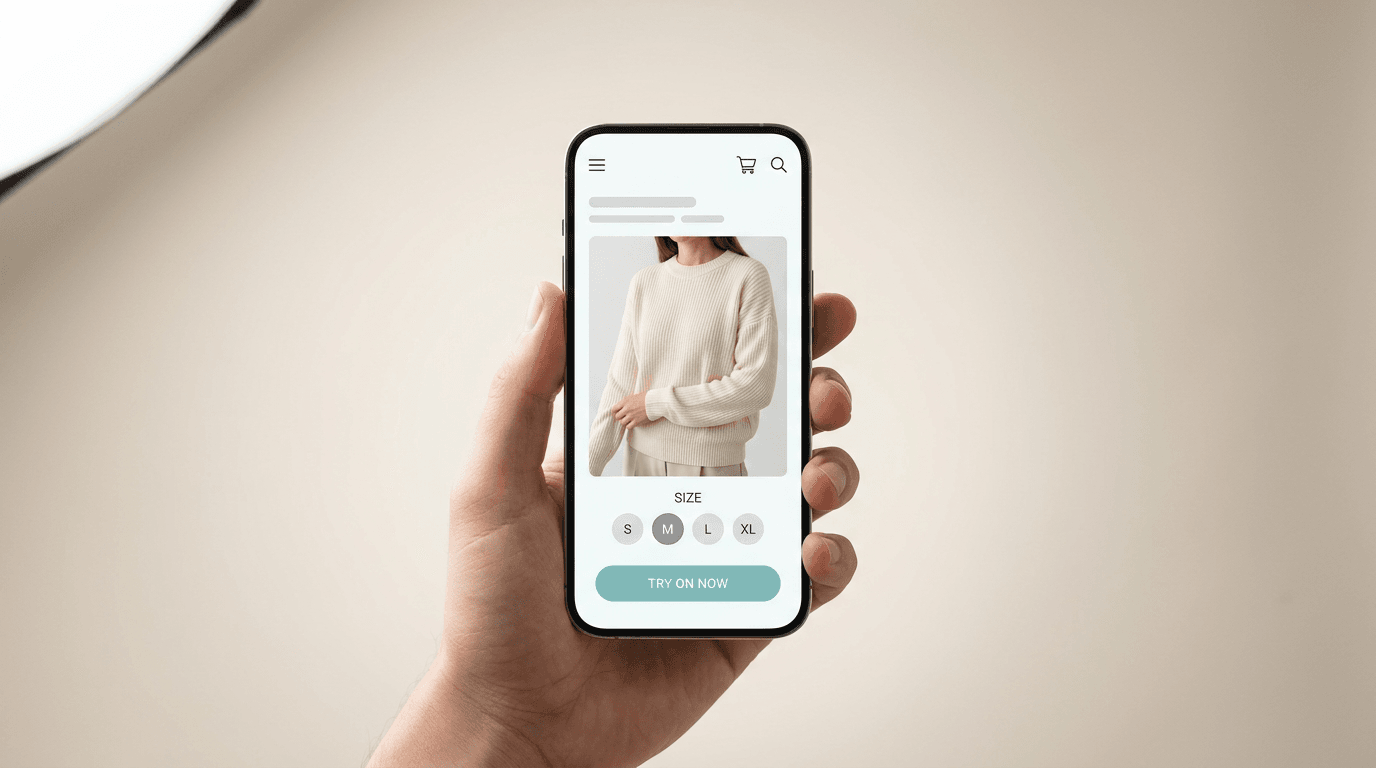
Adding a virtual try-on feature to a clothing store takes five steps: audit your product imagery, pick and test a provider on your own SKUs, prepare the catalog, place and style the widget, then run a limited release before you turn it on everywhere. Most of the work is catalog prep, not code.
- Audit your product imagery first. Every garment needs a clean, front-facing source image at decent resolution, with the full item visible. This is where most implementations stall. Fix it before you shop for vendors.
- Shortlist and test on your own catalog. Pick your three hardest items, not your easiest. A structured jacket, a sheer or printed piece, and something plus-size. Ask each vendor to run those. Compare the outputs side by side.
- Prepare the catalog. Map images to variants, decide which items are in scope, and exclude the categories where output quality is not good enough yet. Partial coverage done well beats full coverage done badly.
- Place the try-on tool where the doubt is. Near the size selector, not buried below the fold. Label it plainly. Set the expectation that it shows style, not size.
- Soft launch and measure. Run on a subset of traffic first. Watch add-to-cart rate, return rates by SKU, and support tickets. Then decide whether to implement virtual try-on across the whole catalog.
Brands using virtual try-on well tend to switch on a small set of try-on features first rather than everything at once. And if you integrate virtual try-on through a platform app rather than custom code, most of the technical surface is already handled for you.
On a mainstream platform, the technical setup is a few hours of work when your imagery is already in order, and considerably more when it is not. Our comparison of virtual try-on apps for clothing brands covers the shortlisting step in detail, virtual try-on pricing models covers how vendors structure their billing, and our roundup of virtual try-on software platforms is the wider market view beyond clothing.
The ROI of Virtual Clothing Try-On for Fashion Retail
Virtual try-on pays back when the margin recovered from avoided returns plus incremental conversion exceeds the monthly cost of the software. For most apparel brands the returns side dominates, because a return costs roughly 27% of the item price to process (Optoro) while try-on software costs a flat monthly fee.
Run it on your own numbers:
Monthly returns avoided  = monthly orders x return rate x expected reduction
Margin recovered         = returns avoided x average order value x 0.27
Conversion upside        = monthly sessions x conversion lift x AOV x gross margin
Payback (months)         = software cost / (margin recovered + conversion upside)
Use a conservative reduction assumption. If a vendor tells you 40%, model 15% and see whether the case still holds. If it does, you have a decision that survives being wrong.
The costs people forget: catalog image cleanup, the internal time to review generated output before it goes live, and the ongoing per-SKU work as new collections land. None of these are large. All of them are larger than zero.
How fast you break even depends almost entirely on where your return rate starts. A brand at 30% returns and a brand at 8% returns are running two completely different calculations from the same software price, which is why a single industry payback number would be meaningless.
For the full business case, including how to present it internally, see our ROI guide for clothing brands, and our guide for smaller DTC brands if you are working with a tighter budget.
How Rooop Approaches Virtual Clothes Try-On
We build this, so treat what follows as a vendor describing their own product.
Rooop is an AI-powered virtual try-on rather than an AR one. A shopper uploads a photo or picks a virtual model, and gets back a generated still. No camera permission, no app install, works the same on a desktop as on a phone. The reason we went this way is the one from earlier in this guide. For clothing, generated stills handle fabric better than live overlays do.
What we optimize for is output quality on real catalogs rather than on demo shots. We hold try-on images to 99% visual fidelity, and when a source photo is difficult, an unusual pose, a cropped frame, poor lighting, the system reruns it rather than returning something broken. A shopper sees a photorealistic try-on image, or they see nothing.
On integrations, there is a native Shopify app, a WooCommerce plugin, BigCommerce support, and an API for custom platforms. When your product imagery is already clean, setup is a short job rather than a project.
Where Rooop is not the right answer, stated plainly. Complex 3D jewelry with heavy reflections is better served by AR-based tools. Structured outerwear is our hardest apparel category. And we do not do fit prediction: virtual try-on helps customers judge style, and your size chart still has a job.
Pricing runs at $24, $119 and $399 per month depending on volume, with 20% off on annual billing. You can see the current plans at rooop.app. If you sell accessories alongside clothing, our accessories try-on guide covers jewelry, eyewear and footwear, and there is a dedicated piece on virtual shoe try-on.
The Future of Virtual Try-On and Digital Fashion
Three things look likely over the next couple of years.
Video try-on becomes usable. The research is already there in preprint form, and the gap between a still and a short clip is the gap between "I can see it" and "I can see how it moves". That closes the biggest remaining experiential difference with a physical fitting room.
AI-generated models absorb part of the photography budget. Brands are already generating on-model imagery per SKU rather than shooting every colorway. That is the generation-side story rather than the try-on story, and it is covered in our piece on AI clothes changer technology.
Fit data and try-on converge. Right now they are separate products from separate vendors. The obvious next step is a single experience that shows you the garment and tells you the size, and whoever gets that right first will take the category.
What I would not bet on is full 3D digital fashion becoming the mainstream path for online fashion retail. A per-garment 3D model is expensive to produce, and generative systems keep getting better at producing the same result from a flat product photo. The economics point one way. The future of virtual try-on for clothing looks like better generation, not more asset production, and the future of fashion ecommerce probably looks less like a metaverse and more like a product page that finally answers the question shoppers were already asking.