Key Takeaways
- A virtual try-on dress feature renders a specific dress onto a shopper's own photo, so they see length, drape and proportion on their body instead of guessing from a product shot.
- Dresses are the hardest garment for virtual try-on technology to get right, because a dress is defined by how fabric falls rather than by where seams sit.
- For a brand selling dresses online, the payoff shows up in return rates. Shoppers sent back 19.3% of online sales in 2025 according to the National Retail Federation and Happy Returns, and each return costs roughly 27% of the item's price to process.
Say you sell dresses online. You have good photography, an honest size chart, maybe a fit-model note on every listing. And your returns still come back at a rate that makes your accountant wince, almost always with the same reason code attached. Wrong fit. Or worse, no reason at all, just a box.
The frustrating part is that you already know why. A dress photographed on one 5'10" fit model tells your customer almost nothing about how that dress will fall on a 5'3" body with different proportions. So she orders two sizes. Sometimes three.
Virtual try-on is the technology everyone points at as the fix. This article covers what virtual try-ons actually do, how the AI works under the hood, and where the technology still falls apart, with a specific focus on dresses because dresses are the interesting case. Full disclosure before we start: Rooop makes AI virtual try-on for ecommerce brands, so we have a stake in this. That is exactly why the limitations section below is as long as it is.
What is a virtual try-on dress experience?
A virtual try-on dress feature lets a shopper upload one photo and see a specific dress rendered on their own body, at their own proportions, before buying. Modern virtual try-ons use generative AI rather than augmented reality, so no camera access is needed and the try-on image arrives in seconds on any device.
The term covers two quite different technologies that get lumped together, and the difference matters more than any vendor comparison chart.
Augmented reality try-on overlays a digital garment onto a live camera feed. It asks for camera permission, runs in real time, and works beautifully for rigid objects that sit on a fixed point of the body. Glasses. Watches. Earrings. The object does not change shape, so the software only has to track where your face or wrist is. AR overlays digital objects onto the world. That is the whole trick, and it is a good trick for the right product.
AI virtual try-on takes a still photo and generates a new image of that person wearing the garment. Nothing is overlaid. The try-on image is created from scratch by a model that has learned what clothing items look like on real bodies. This is the approach that works for soft goods, and it is why the category suddenly got useful for online fashion around 2023 and after.
For dresses, AI virtual try-on is the only one of the two with a real shot. An AR overlay of a dress looks like a sticker on a photo, because a dress has no fixed geometry to track.
Either way the job is identical. Let a shopper see how clothes will actually sit on her body so she can judge fit and look before buying rather than after the parcel lands. That visualization is the entire product. Everything else is plumbing.
If you want the wider version of this explanation across every clothing category, we wrote a longer piece on how virtual clothes try-on works end to end, and a broader overview of virtual try-on technology across ecommerce.
How virtual try-on technology works for dresses, step by step
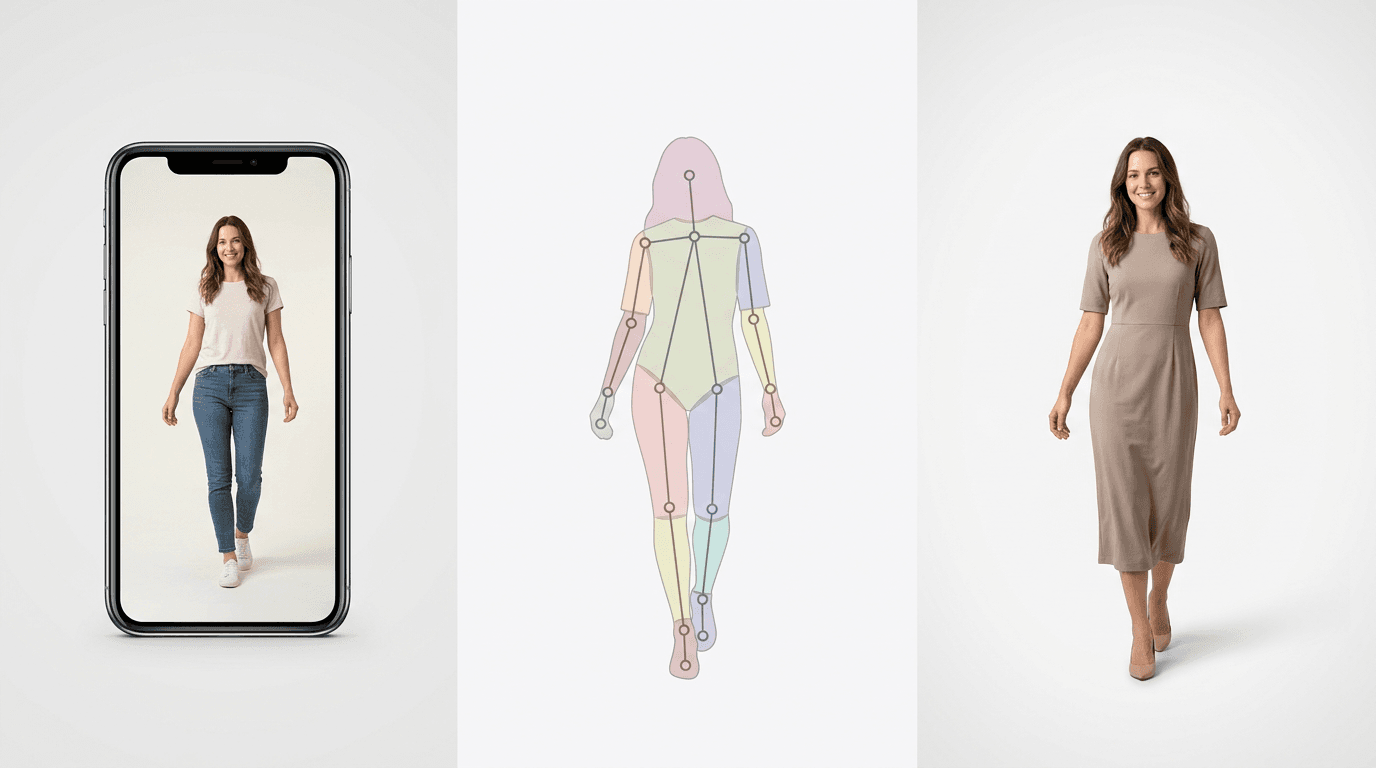
A virtual dress try-on runs in three stages. The shopper uploads a photo, a computer vision model reads their body shape and pose, and a generative model renders the garment onto that body with matching lighting and shadow. The whole sequence completes in seconds and returns a single try-on image.
Here is what happens between the upload and the result. This is the part most explainers skip, and it is the part that tells you why some virtual try-ons look convincing and others look like a bad collage.
Step 1: The shopper uploads a photo
One full-body photo, front facing, reasonable light. That is the entire input. No measurements, no depth scan, no app download. The shopper uploads a photo and waits a moment.
This is the part brands underestimate. The quality of the try-on image is capped by the quality of the input photo. A shot taken at arm's length in a dim bedroom will produce a worse result than one taken in daylight against a plain wall, and no amount of model sophistication fixes that. Photo guidance in your interface is not a nice-to-have. It is the single cheapest thing you can do to improve output quality across your whole online store.
Step 2: The AI model reads body shape and pose
Two things happen here, and they are separate computer vision problems.
Pose estimation finds the body's joints and posture. Shoulders, elbows, hips, knees. The output is a skeleton, essentially, telling the system how the person is standing and which way they are facing.
Semantic segmentation labels every pixel as person, existing clothing, or background, and separates body regions from each other. This is what lets the system know where the current outfit ends and the arm begins, so it can replace one without mangling the other.
Together these give the model a structural map of the body shape it is working with. Not measurements. A map. That distinction matters, and it comes back in the FAQ, because a virtual try-on tells you how a dress will look on you and not what size you are.
Step 3: The garment is warped, rendered and returned
The dress now has to be deformed to fit that map, then rendered so it looks photographed rather than pasted.
Current systems handle this with generative AI, specifically diffusion models conditioned on the garment image. The model starts from noise and denoises toward a target image, with the garment's texture, pattern and construction steering the process at every step. Recent research, including the DiffFit and garment-focused diffusion papers, is largely about keeping garment detail intact through that denoising, since the naive approach smears texture and loses pattern alignment across seams.
The rendering step also has to match lighting from the original photo and generate shadow where fabric meets body. Get that wrong and the result reads as fake instantly, even when the shape is correct. Shadow is doing far more work in a convincing try-on image than most people realise.
AI virtual try-on vs augmented reality fitting rooms
| AI virtual try-on | AR virtual fitting room | |
|---|---|---|
| Input | One uploaded photo | Live camera feed |
| Permissions | None | Camera access required |
| Output | Generated try-on image | Real-time overlay |
| Best for | Dresses, tops, soft garments | Glasses, watches, jewelry |
| Handles fabric drape | Yes, learned from fashion imagery | Poorly, geometry is rigid |
| Device requirements | Any browser | Newer phones for good results |
Neither is universally better. AR wins when a shopper wants to move and see an object track with them. AI wins when the product is soft and the real question is how it hangs. We went deeper on that trade-off in AI vs AR virtual try-on, and on the related 2D vs 3D question if you are being pitched 3D modeling as a requirement.
Why dresses are the hardest garment for virtual try-on
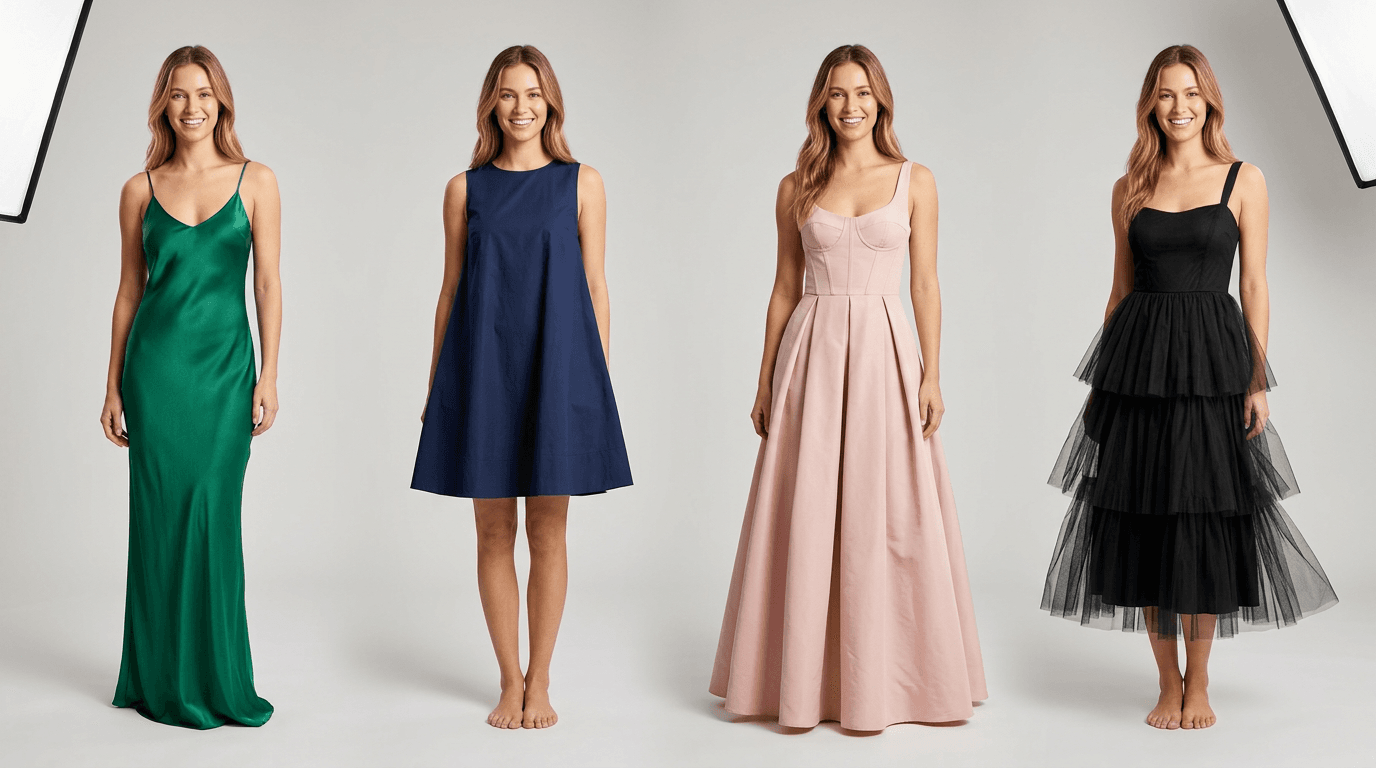
Dresses are the worst case for virtual try-on because their silhouette comes from drape rather than from structure. A dress is the longest continuous run of fabric a person wears, it hangs from two narrow anchor points at the shoulders, and its finished length depends on the height of whoever is wearing it.
This is the section I would read first if you are evaluating vendors, because it tells you exactly what to test.
A t-shirt is comparatively easy. It sits close to the torso, its shape is defined by seams, and its length is fixed relative to the shoulder. A model can learn "t-shirt on body" fairly reliably from a moderate amount of fashion imagery.
A dress refuses to behave that way. Three specific reasons.
Fabric behavior varies enormously across the same silhouette. A slip dress in heavy silk and the same pattern cut in stiff cotton poplin hang completely differently. One clings and pools, the other holds its own shape away from the body. The garment photo alone does not always tell the model which it is dealing with, and getting this wrong is the most common failure in try-on output.
Length is relative, not absolute. A midi dress is midi because of where it lands on a particular person's calf. On a shorter wearer the same garment reads as a maxi. Any system that renders the dress at a fixed proportion of the frame gets this wrong for most of your customers, which defeats the entire point of the exercise.
Volume and layering break the geometry. Tulle, ruffles, tiered skirts, anything with structure built into the garment rather than draped from it. These have shape independent of the body underneath, and models trained mostly on flat-lay garment images tend to flatten them into something limp.
The honest summary is that current AI technology handles simple silhouettes well, handles complex construction inconsistently, and should be evaluated by you on your own hardest products before you commit. Ask any vendor to run your most structured dress, not their demo catalog. The academic literature agrees on the underlying point, incidentally: work like DiffusionTrend frames garment complexity, pose and image quality as the variables that decide whether a virtual try-on holds up.
Virtual try-on across dress styles and use cases
Virtual try-on technology performs differently by dress category. Simple everyday silhouettes render reliably. Occasion wear with structured construction is inconsistent. Bridal is the hardest case of all and works best as a shortlisting tool rather than a substitute for an appointment.
Four use cases, four different answers.
Casual and everyday dresses
This is where the technology is genuinely solid. Shift dresses, wrap dresses, jersey and cotton pieces, simple A-lines. The fabric drapes predictably, the construction is straightforward, and the shopper's question is usually about proportion rather than fine detail. If your catalog is mostly everyday dresses, virtual try-on will work for most of it today, and the try-on experience will feel unremarkable in the good way.
Formal and occasion dresses
Mixed results. A column gown in matte crepe renders well. A dress with boning, an internal corset, or heavy beadwork gets less reliable, because the garment's shape comes from construction the model cannot see in a product photo.
There is a business case here even so. Occasion wear carries a high price point and an even higher return rate, so a preview that eliminates the obviously-wrong options still pays for itself. A shopper who rules out three dresses without ordering them has saved you three returns.
Wedding and bridal dresses
Bridal is a large chunk of the search demand around virtual dress try-on, and it deserves a straight answer. Virtual try-on is useful for narrowing a shortlist from twenty dresses to four. It is not useful for the final decision. Lace texture, train weight, how the thing actually moves when you walk, none of that survives a still image.
Brands that position virtual try-ons as "see your dress before your appointment" do well. Brands that position it as a replacement for the appointment generate disappointment and complaints, which is a worse outcome than not offering it.
Plus-size and inclusive sizing
Worth saying clearly, because this is where the technology has the most to offer and the most to prove. Shoppers outside the sample-size range get the least useful information from standard product photography, so virtual try-on has the highest marginal value for them.
Whether it delivers depends entirely on what body types the model learned from. A system trained mainly on straight-size fashion imagery will render plus-size bodies badly, and shoppers notice immediately. Vendors do not generally publish their dataset composition, which makes this a question you have to ask directly and judge by the answer. Then test it on real photos across the size range you actually sell.
For the broader shift in shopper behavior sitting behind all of this, see our piece on trying clothes on at home.
Virtual fitting rooms, digital avatars and virtual models: what the terms mean
The category uses four terms loosely. A virtual fitting room is the on-site feature, a digital avatar is a synthetic stand-in body, a virtual model is an AI-generated person wearing your product, and virtual try-on is the shopper seeing the garment on their own photo. Only the last one answers "will this suit me".
This section exists because vendors use these words interchangeably and they should not.
A virtual fitting room is the container. It is whatever interface on your online store lets a shopper try on clothes without a physical fitting room, allowing customers to judge a garment from their sofa. The term describes the feature, not the technology behind it.
A digital avatar is a synthetic body built from a shopper's rough measurements or a body-type selection. The garment gets rendered on the avatar rather than on the person. Avatars are cheap and consistent, and they are also the reason a lot of early virtual fitting room products felt useless: an avatar that is approximately you is not you, and shoppers can tell.
A virtual model or digital model is an AI-generated person wearing your product for catalog purposes. It solves a production problem, not a shopper problem. Nobody sees themselves in it. This is a genuinely valuable use of the same underlying AI tools, and we covered it separately in AI clothes changer technology.
Virtual try-on is the shopper's own photo. That is the whole distinction, and it is the one that changes buying behavior, because the question a hesitating shopper is asking is not "what does this dress look like" but "what does this dress look like on me".
Some systems bolt on 3D modeling of the garment for extra fidelity. That improves certain outputs and adds meaningful cost per SKU. For a dress catalog turning over seasonally, per-garment 3D work is usually the wrong economics, which is why image-based generative approaches took over.
How virtual try-on reduces dress returns for ecommerce brands
Return rates are the clearest business case. The National Retail Federation and Happy Returns put 2025 online returns at 19.3% of sales, worth $849.9 billion across US retail. Optoro estimates each return costs about 27% of the item's purchase price to process, which can erase up to half the margin on that sale.
Those two numbers together are the whole argument, so it is worth sitting with them for a moment.
The 2025 Retail Returns Landscape from NRF and Happy Returns found that 19.3% of online sales came back, and that returns totalled $849.9 billion, or 15.8% of annual retail sales. Apparel sits above that all-category average, which will surprise nobody who has run an online fashion store through a January.
Then the cost side. Optoro's figure of roughly 27% of purchase price covers return shipping, inspection, restocking and the markdown on anything that cannot go back to the shelf at full price. On a $120 dress that is around $32 gone, against a sale that already happened and now unhappens. Optoro also puts the margin damage as high as half the sale.
The mechanism by which virtual try-on helps is simple and worth stating precisely: it removes the reason to bracket. A shopper who orders three sizes intending to return two is doing that because she cannot tell which one is right. Give her a preview at her own proportions and the ordering behavior changes at the source, before the box ships rather than after.
That is a different intervention from a better size chart or a slicker returns portal. Those manage returns after the fact. This one prevents the order pattern that creates them.
The same NRF and Happy Returns report found 82% of shoppers weigh free returns when deciding where to buy, which is the tension every apparel retailer lives inside. You cannot tighten the returns policy without losing sales. Reducing the returns themselves is the only move that does not cost you conversion. The report also found that 9% of returns are fraudulent and that 76% of consumers prefer a return option offering an instant refund or exchange, which tells you how much shopper expectation has hardened around this.
What virtual try-on does for conversion, AOV and customer experience
Beyond return rates, virtual try-on changes the shopping experience at the moment of hesitation. A shopper who can preview a dress on herself gets an answer to the question that was about to make her close the tab, which is why the feature tends to move conversion and average order value rather than traffic.
Three things happen on the page.
The first is confidence at checkout. The hesitation on a dress product page is almost never about whether the dress is nice. It is about whether it will work on this particular body. A preview answers that where the doubt occurs, rather than sending the shopper off to read forty reviews hunting for someone with similar proportions.
The second is customer engagement. Virtual try-ons turn a static product page into an interactive shopping experience, and shoppers who use the feature spend meaningfully longer with the product. Longer sessions on a product page are not a vanity metric for online fashion. They correlate with a shopper deciding rather than drifting.
The third is that it works on mobile, which is where the traffic is. A photo-upload flow needs no app, no camera permission dialog, no depth sensor. It runs in the mobile browser the shopper is already using, which matters more than any feature comparison.
There is a personalization angle too. Once a shopper has uploaded a photo, every subsequent product page can personalize what she sees, which is a genuinely different online shopping experience from a grid of the same fit model in forty outfits. That is personalized shopping in the useful sense rather than the recommendation-engine sense, and it is one of the few online shopping experiences that gets better the longer someone browses.
One honest caveat. Published conversion and AOV lift figures in this category come overwhelmingly from vendors describing their own customers, including us, and they are not independently audited. Treat every number you are quoted as a hypothesis to test on your own store rather than a benchmark to plan against. Run it on a subset of your catalog and measure your own return rates before and after.
How virtual try-on technology bridges in-store and online shopping
Virtual try-on started as an online feature but increasingly connects the physical and digital sides of a fashion brand. The same technology that renders a dress on a shopper's photo at home can run on an in-store tablet, extending a small physical range into the full catalog.
Most dress brands with a physical presence carry a fraction of their range in-store. Floor space decides that, not demand.
A virtual fitting room on an in-store screen changes the maths. A customer who likes a style but needs a different colorway can see it rather than being told it exists. That is an immersive version of the endless-aisle idea that retailers have been chasing for a decade, and it is now cheap enough for a single-boutique brand rather than only for chains.
It runs the other way too. Shoppers who have used virtual try-ons online arrive in-store having already narrowed their options, which shortens fitting room queues and changes what your staff spend time on.
The broader point is that the physical and digital sides of fashion retail stopped being separate channels a while ago. Virtual try-on is one of the few technologies that is genuinely useful on both sides of that line. Our guide to virtual fitting room technology goes further into the implementation side.
What dress brands should look for in a virtual try-on tool
Evaluate a virtual try-on tool on your own hardest products, not on a vendor demo. The questions that separate the tools are how the model handles drape, whether it renders length relative to the wearer, what body types it learned from, and how much work each SKU costs you.
A checklist you can actually run, in the order I would run it.
- Send them your five most structurally complicated dresses and look at the output. Not their catalog. Yours. If a vendor will not do this, that is your answer and you have saved yourself a month.
- Check length rendering across different heights. Ask for the same dress on a short and a tall body. If the hemline lands in the same relative spot on both, the system is faking it.
- Ask what body types the model learned from, and then test it yourself across the size range you sell. Vague answers here predict bad output for a large share of your customers.
- Look at the failure mode, not the success rate. Every AI try-on system fails sometimes. What matters is whether it fails visibly, producing something obviously wrong, or invisibly, producing something plausible but inaccurate. Visible failures are far safer commercially, because a shopper discards them instead of trusting them.
- Check the operational cost. How much work per SKU? If each dress needs manual preparation, multiply that by your catalog size and your seasonal turnover before you sign anything.
- Confirm the platform fit. Shopify, WooCommerce, BigCommerce, whatever runs your online store. An integration needing developer time is a different project from one that does not.
We compared the current options in more detail over on virtual try-on clothes apps for DTC brands, and there is a smaller-catalog version of the same question in virtual try-on for small business.
What does virtual try-on cost for a dress brand?
Virtual try-on pricing for small and mid-sized fashion brands now sits in the tens to low hundreds of dollars a month rather than the enterprise contracts the technology used to require. Rooop's published plans run $24, $119 and $399 per month, with 20% off annual billing.
Pricing in this category used to be the blocker. It largely is not any more, at least at the entry end.
Checked on rooop.app on 3 August 2026, the plans are Starter at $24 a month for 150 credits, Pro at $119 a month for 600 credits, and Business at $399 a month for 1,200 credits, with 20% off if you pay annually. Shopify installs in one click, and WooCommerce and BigCommerce are listed as on the way. Rooop's virtual try-on renders at 99% visual fidelity, and because it works from an uploaded photo rather than a live camera feed, there is no permission prompt standing between a shopper and her try-on image.
We are not going to quote competitor pricing here, because prices in this category change constantly and most vendors publish nothing at all. Ask each vendor directly and get it in writing.
The number that actually matters is not the subscription anyway. It is the comparison against what a return costs you. Using Optoro's 27% figure, a brand selling $120 dresses loses roughly $32 every time one comes back. Work out how many prevented returns cover a monthly plan at your own price points. I would rather you did that arithmetic on the back of an envelope than trusted a vendor ROI calculator, including ours. If you want the framework rather than the sums, we wrote it up under virtual try-on pricing models and ROI.
For the implementation-side detail rather than the concept, that lives on our virtual try-on for clothing brands page.
The future of virtual try-on in fashion retail
Virtual try-on is moving from a novelty feature to a default expectation in online fashion, driven by generative AI models that keep getting better at fabric. The near-term shift is from single try-on images toward video and multi-garment outfit previews.
A few things look reasonably clear from where the research is heading.
Fabric fidelity keeps improving, and faster than most people expected. The gap between "obviously generated" and "looks photographed" has closed considerably in about three years, and the run of academic work on garment-conditioned diffusion suggests it keeps closing. Advanced AI models are getting specifically better at the thing dresses need, which is drape.
Video is the obvious next step. A try-on image answers how a dress looks. It does not answer how it moves, which for a dress is half the question. Several research groups and vendors are demonstrating video try-on, though production deployments at real ecommerce scale are still thin on the ground. Treat any video try-on pitch as early technology and ask to see it running on a live storefront.
The other shift is from garment to outfit. An outfit try-on that shows the dress with the shoes and the jacket is closer to how people actually shop, and it moves the feature from a product-page widget toward something more like a styling surface. That is where virtual fashion gets genuinely interesting, and where the line between virtual shopping and digital fashion starts to blur.
Underneath all of it, the same generative models are quietly changing the production side too. The same AI technology that puts a dress on a shopper puts it on a catalog model, which is why fashion trends in AI adoption tend to show up in the photo studio before they show up on the product page.
If you want the one-line version of where the fashion industry is heading: the future of fashion online looks less like a catalog and more like a mirror. Product pages powered by AI stop showing you a stranger in the dress and start showing you yourself. Virtual try-on solves a problem that flat photography has never been able to solve, which is why the feature keeps spreading even though the technology is still visibly imperfect.